


Garden lighting – how far apart should bollard lights and drive-over fixtures be placed along a path and driveway?
The spacing of garden lights should be adjusted to the height of the fixture, the width of the surface, and the light range. Different types of garden lighting are needed for paths and driveways to achieve proper illumination. How far apart should they be placed to ensure even and practical lighting after dark? We explain.
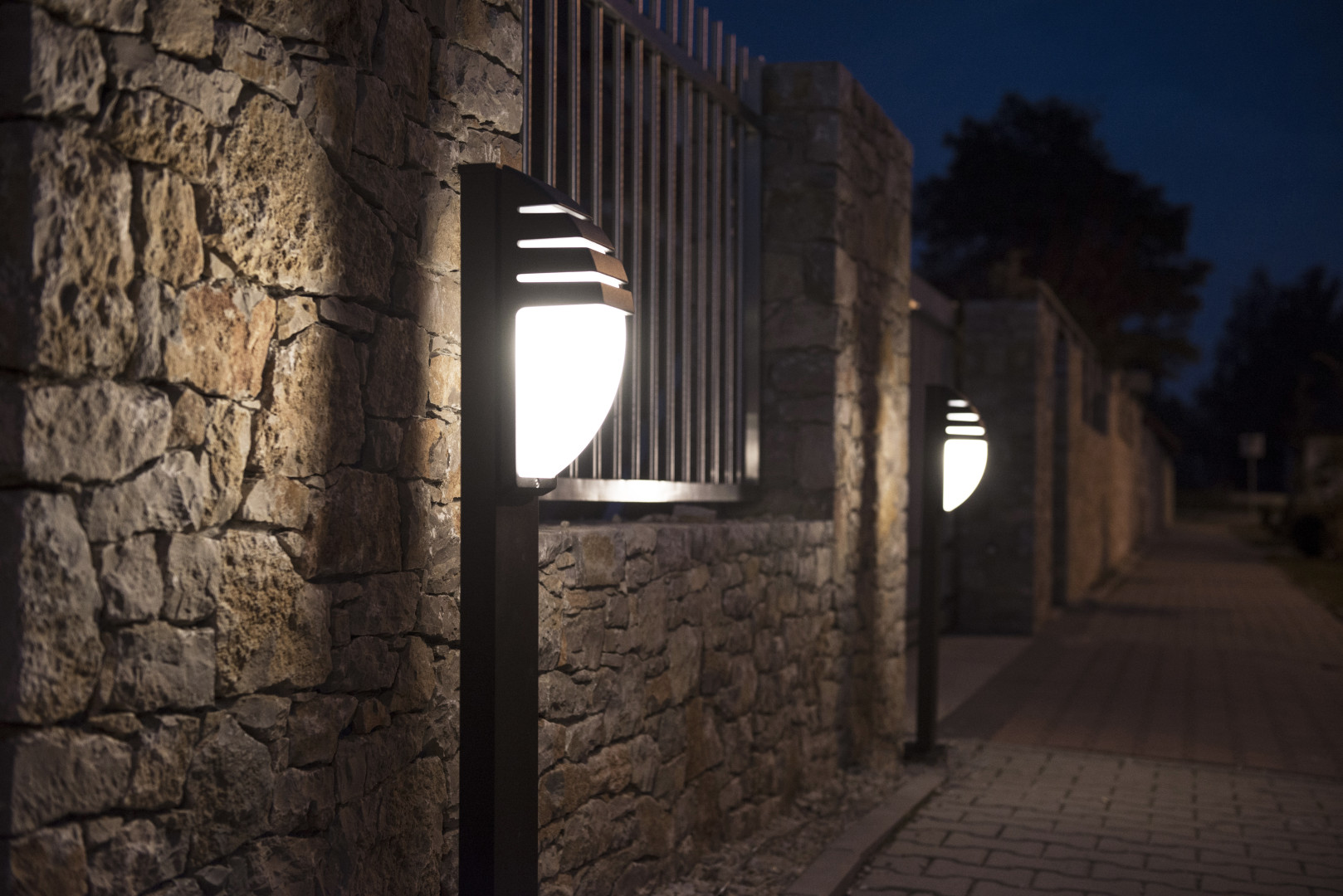
Garden lighting – how far apart should bollard lights and drive-over fixtures be placed? Key information
- Garden lights along a path or driveway are most commonly placed every 1.5–2 m.
- Bollard lights with a height of 60–90 cm are usually spaced about 3–4 m apart along a driveway or path.
- Drive-over fixtures are most often installed every 2–2.5 m, as they shine lower and provide more focused light than bollards.
- The final spacing depends on the width of the path or driveway, the power and type of light, and the beam angle. The lower or more focused the fixture, the smaller the spacing between lights is usually required.
- If you want a subtle effect, the spacing can be greater. If stronger illumination is needed, the fixtures should be placed closer together.
What determines the spacing of garden lights along a path and driveway?
The spacing of lighting fixtures depends on the height of the fixture, the width of the surface, the power and type of bulb, and the desired lighting effect. These five factors determine whether the fixtures can be placed farther apart or need to be positioned more densely. It is also worth considering the layout of the route itself, especially bends, intersections, and areas near the entrance or garage gate.
Learn more: Lighting for pathways and driveways around your property
Garden lights – how far apart should they be placed along a path and driveway?
As a standard, garden lights along a path or driveway are placed every 1.5–2 m. This spacing usually works well for walkways leading to the house or driveways leading to the garage.
For narrow or winding paths, it is better to reduce the spacing to 1.2–1.8 m, as the light should guide more precisely around bends and changes in direction. If you choose bollard lights with a height of 60–90 cm, spacing them every 3–4 m is usually sufficient.
In the case of drive-over fixtures along a driveway, the light range and the way the fixture covers the surface are very important. These fixtures are usually installed more densely because they shine lower and have a more focused effect than bollard lights. Therefore, a spacing of around 2–2.5 m works best if you want to clearly define the route and edges of the surface.
Garden light spacing and the power and type of fixture
The power of the fixture affects the light range. Fixtures with a power of 5 W usually illuminate an area within a radius of about 1–2 m, so they need to be placed closer together. More powerful fixtures, for example 20 W, can cover an area of around 4–5 m, allowing for greater spacing and reducing the number of lighting points along a path or driveway.
The way the light is distributed is also very important. Fixtures with a wide beam angle, around 120–180°, can usually be spaced about 4–6 m apart. Fixtures with a narrow beam angle, for example 30–60°, focus the light on a smaller section of the surface. In this case, it is better to reduce the spacing to around 2–3 m.
When planning the installation, it is also worth considering the lighting technology. LED fixtures are more efficient than older traditional ones, so with the same amount of light they allow the spacing to be increased by as much as 20–30%. This is especially useful if you want a minimalist garden lighting arrangement while still ensuring good illumination of the path or driveway.
Bollard lights or drive-over fixtures – which should you choose for lighting a path and driveway?
Bollard lights illuminate the space from above more effectively, which is why they are more commonly used along paths leading to the house. Drive-over fixtures emphasize the line of the surface more strongly and are more often chosen for driveways.
In many outdoor lighting projects, both solutions are combined because each type of fixture serves a different function.
In our range, you will find both garden bollards and drive-over lights that can be matched to the layout of the paths, the width of the driveway, and the way you want to illuminate the property. Thanks to the variety of models available, it is easier to choose a solution suited to the size of the yard, the style of the surface, and the effect you want to achieve after dark.