


Electric or Solar Garden Lights – Key Differences and Advantages of Mains-Powered Lighting
Solar lights do not need to be connected to an electrical installation, but their operation depends on the energy stored in the battery. Electric garden lights use a continuous power supply, making them a good choice for illuminating paths, driveways, entrances and steps. What are the differences between these two solutions, and when is it better to choose mains-powered lights? Here is what you need to know.
Electric vs Solar Garden Lights – Key Information
- Electric lights are powered by the electrical installation, while solar models use energy stored in a battery charged by a solar panel.
- A solar light’s operating time depends, among other things, on the battery’s charge level.
- The installation location of a mains-powered light is not limited by the sunlight needed to charge a solar panel, but the power supply must be planned in advance.
What Is the Difference Between Electric and Solar Garden Lights?
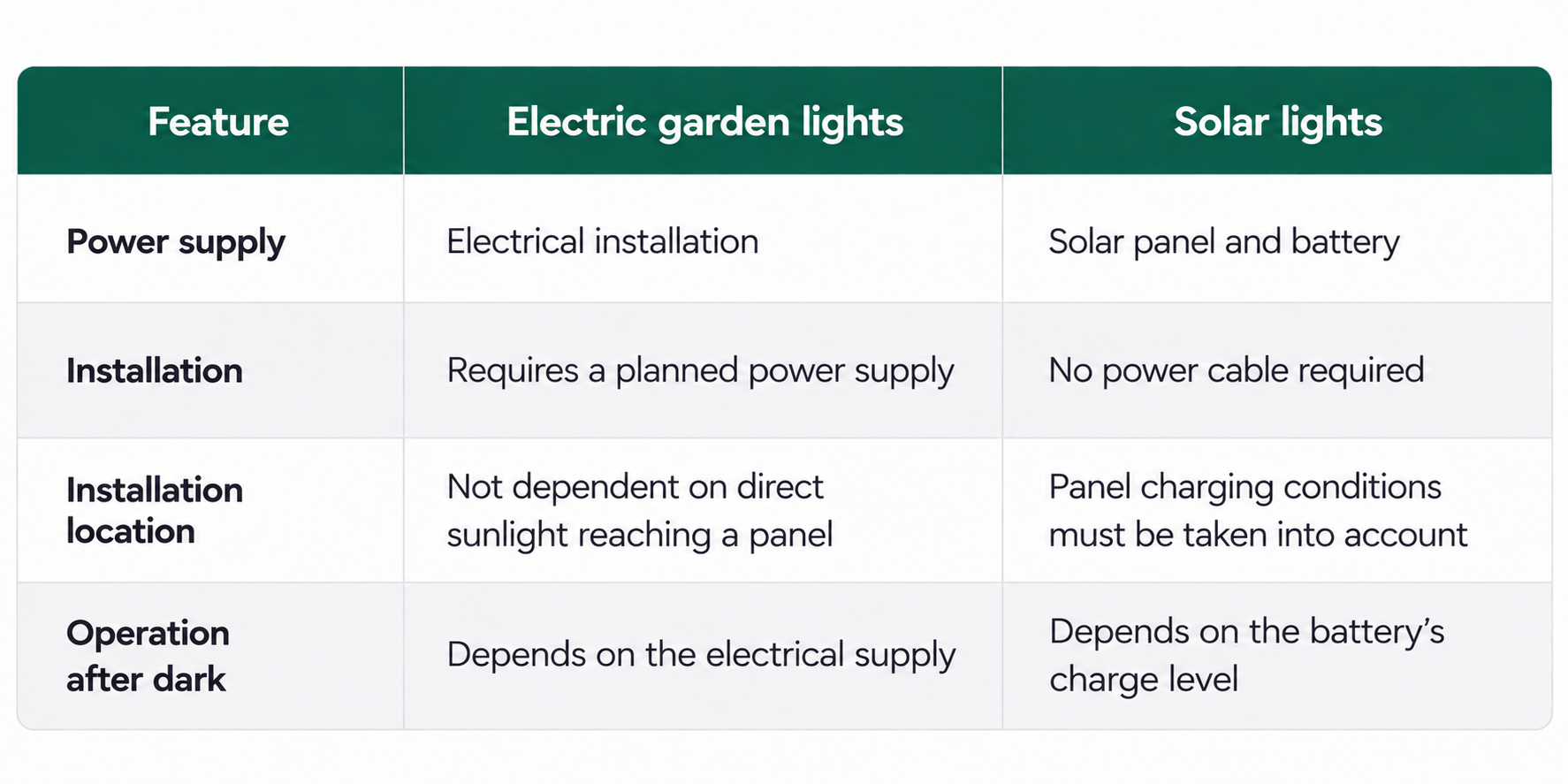
The main difference lies in the power source. Electric garden lights are connected to the electrical installation, while solar models collect energy through a panel and store it in a battery. This affects both where the lights can be installed and how they operate after dark.
Table: Electric and Solar Garden Lights – Key Differences
Advantages of Electric Garden Lights
Mains-powered garden lights offer several advantages worth considering when planning outdoor lighting around your property:
- The ability to remain illuminated throughout the night without being limited by battery capacity.
- The option to install lights in a variety of locations, including shaded areas, provided that a power supply is available.
- A wide selection of fittings with different specifications, from subtle step lighting to powerful driveway illumination.
Advantages of Solar Garden Lights
Solar lights also have features worth considering when choosing outdoor lighting for your property:
- No need to install power cables.
- The option to install lights in places where an electrical installation would be difficult or expensive to carry out.
- No electricity drawn from the mains during operation.
Our range also includes the Arma Solar ARS-500SL solar light, worth considering if you are looking for outdoor lighting that does not require connection to an electrical installation.
Read also: Integrated LED or a Light Fitting with a Replaceable Bulb?
Which Electric Garden Lights Should You Choose?
Electric garden lights vary in height, installation method and light direction. A freestanding light can be used along a path, a recessed fitting can illuminate a driveway, and a small low-level wall light can provide lighting near steps. Below, we present popular models from our range.
1. Cube CB-830 DG – For Paths and Walkways to the House
The Cube CB-830 DG The Cube CB-830 DG freestanding light is 83 cm high and powered by a 230 V supply. It is designed for a replaceable E27 bulb with a maximum power rating of 20 W, allowing you to choose a light source with the colour temperature and luminous flux that best suit your needs.
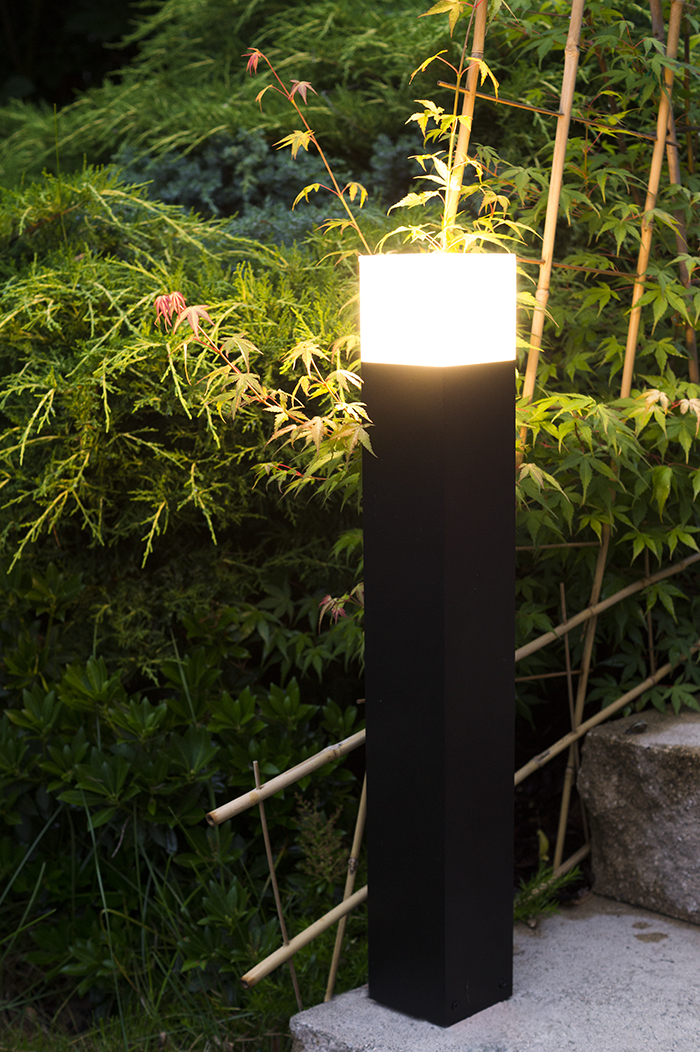
Cube CB-830 DG freestanding outdoor light
You can position this bollard along a path, next to a terrace or on a walkway leading to the house. Its light source is positioned higher than that of a recessed fitting or a light installed close to the ground, allowing it to illuminate a larger area around the fitting.
2. Neo 11702-600 DG – When You Want to Adjust the Direction of the Light
The Neo 11702-600 DG is 60 cm high and features an integrated 10 W LED module, a luminous flux of 600 lm and a colour temperature of 3000 K. Its adjustable head allows you to change the direction of the light, making it possible to illuminate a chosen section of a path, driveway or another area around your home.
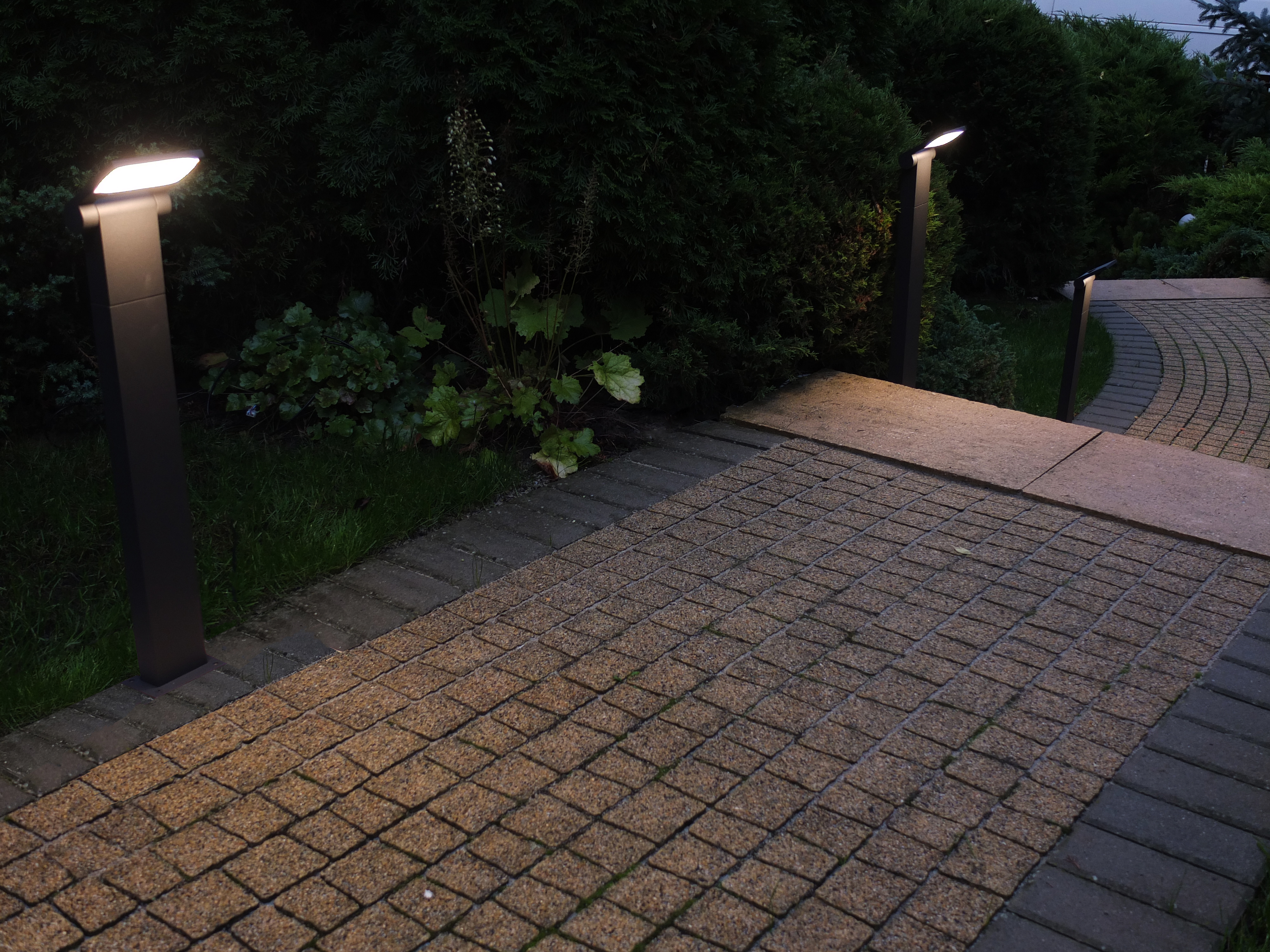
Neo 11702-600 DG freestanding outdoor light
3. Leda ST 5024 – For Installation in Paved Surfaces
The Leda ST 5024 is a recessed ground light powered by a 230 V supply. It has an IP67 protection rating, an integrated 1 W LED, a luminous flux of 86 lm and a beam angle of 25°.
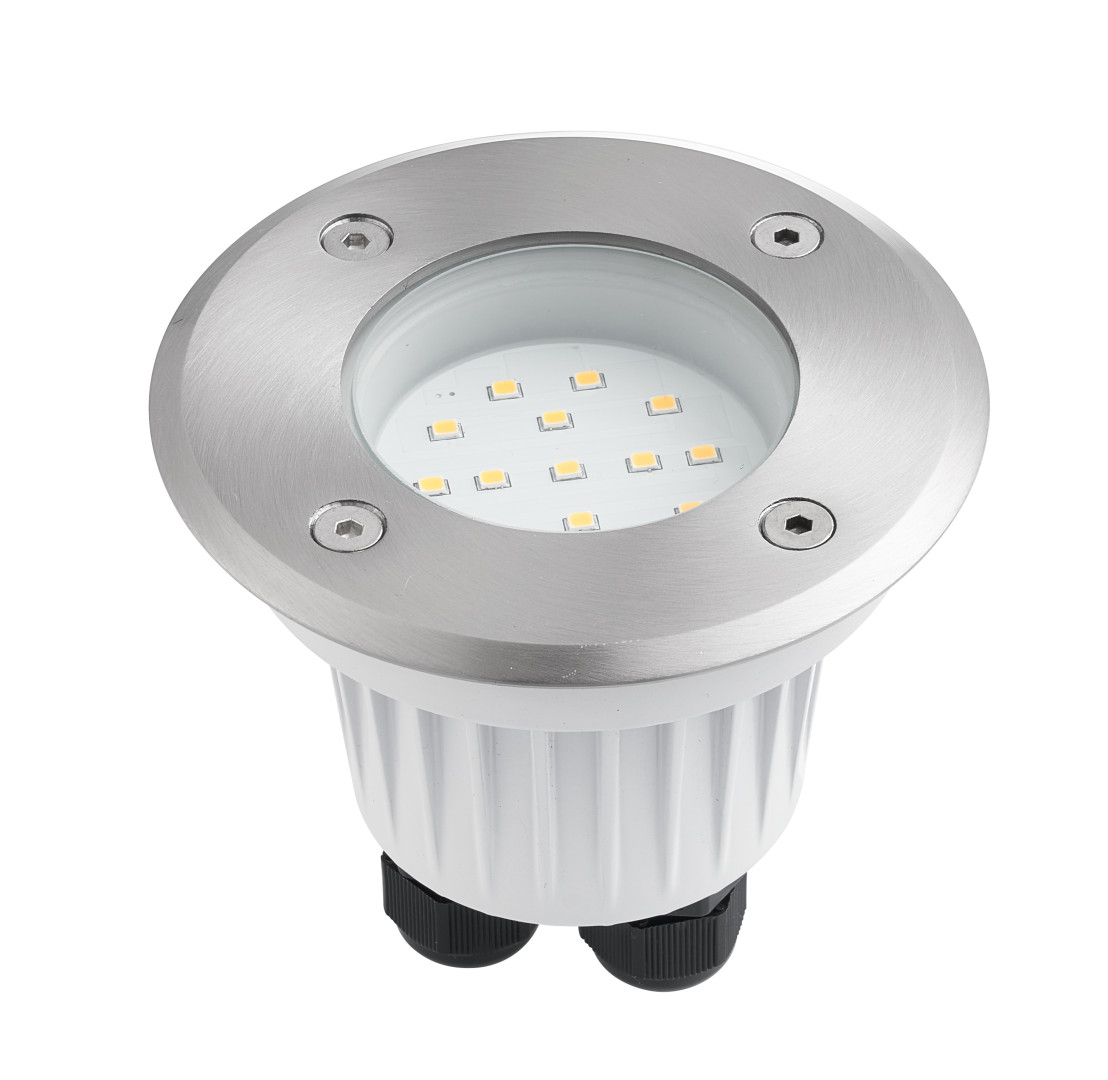
Leda ST 5024 recessed ground light
The fitting can be installed in paving blocks, concrete and other suitably prepared surfaces. Installation directly in the ground requires proper base preparation and adequate drainage.
4. Mur Led Inox E 04 – For Steps and Low Walls
The Mur Led Inox E 04 can be installed in a façade or a low wall. The fitting has a power rating of 1.5 W, a luminous flux of 64 lm, a colour temperature of 3000 K and an IP65 protection rating.
Installed at a low level, this light works well near steps and walkways, illuminating the surface without the need for an additional bollard. The white diffuser softens the light, providing subtle illumination around the fitting.

Mur Led Inox E 04 recessed wall light
Solar or Electric Garden Lights – Which Should You Choose?
Solar lights are particularly useful in places where it is difficult to install power cables or where you need additional decorative lighting. However, remember that shorter days and reduced sunlight in autumn and winter can limit how long they stay illuminated. If you need reliable, long-lasting lighting for an entrance, steps or a driveway, mains-powered fittings are a better choice. You should, however, take into account the cost of preparing the electrical installation and the electricity consumed.
It is best to plan the layout of electric garden lights before constructing paths and driveways. This allows you to run the power supply exactly to the locations where the fittings will be installed, without having to dismantle the finished surface later.