


Installation of Standing Lamps and Light Posts – Step-by-Step Guide
In this guide, you will learn how to properly install standing garden lamps and light posts on your terrace, along garden paths, or in outdoor spaces. The guide provides all the essential tips on preparation, electrical installation, and securing the lamps to ensure safety, durability, and an aesthetically pleasing outdoor lighting setup.
Planning functional and attractive lighting for your garden or terrace? Floor lamps and garden posts are an excellent solution that not only highlights the design of your outdoor space but also improves safety after dark. Installing a floor lamp, whether in the garden or on the terrace, requires precision and adherence to a few key principles to ensure both safety and durability of the installation. While each lamp has its own specifications, our guide provides a universal step-by-step manual showing how to properly install most floor lamps and garden posts, what tools are needed, and what to pay attention to so that your lighting works reliably for years.
Preparing for the Installation of Floor Lamps and Garden Light Posts
Before starting any work related to installing a floor lamp, you should follow a few basic safety rules:
1. Read the instruction manual and safety guidelines
Before starting the installation of garden lighting, it is important to carefully read the user manual provided by the manufacturer. These instructions contain key information regarding assembly, electrical requirements, and safety guidelines. Make sure you understand all the steps as well as the recommendations for using tools and materials that may be necessary for properly installing the lighting system. Keep in mind that each product may have specific requirements, so never skip this step.
2. Turn Off the Power
Before any work on the electrical installation, you must turn off the circuit breakers supplying power to the circuit where the lamp will be connected. To prevent accidental switching by others, secure the breakers with a lock or place a warning note (e.g., a sign indicating that electrical work is in progress). This is a crucial step to prevent electric shock.
3. Prepare Tools and Materials
Prepare all the necessary tools and materials to ensure a smooth and safe installation. Useful tools include a spirit level, a drill with appropriate drill bits, screwdrivers (Phillips and flathead), a utility knife, a wire stripper, a hammer, a tape measure, and a pencil for marking holes.
For materials, have ready: wall plugs and mounting screws, waterproof connectors, a terminal block, protective conduit, electrical wires, and electrical tape.
Outdoor Floor Lamps – Step-by-Step Installation Guide
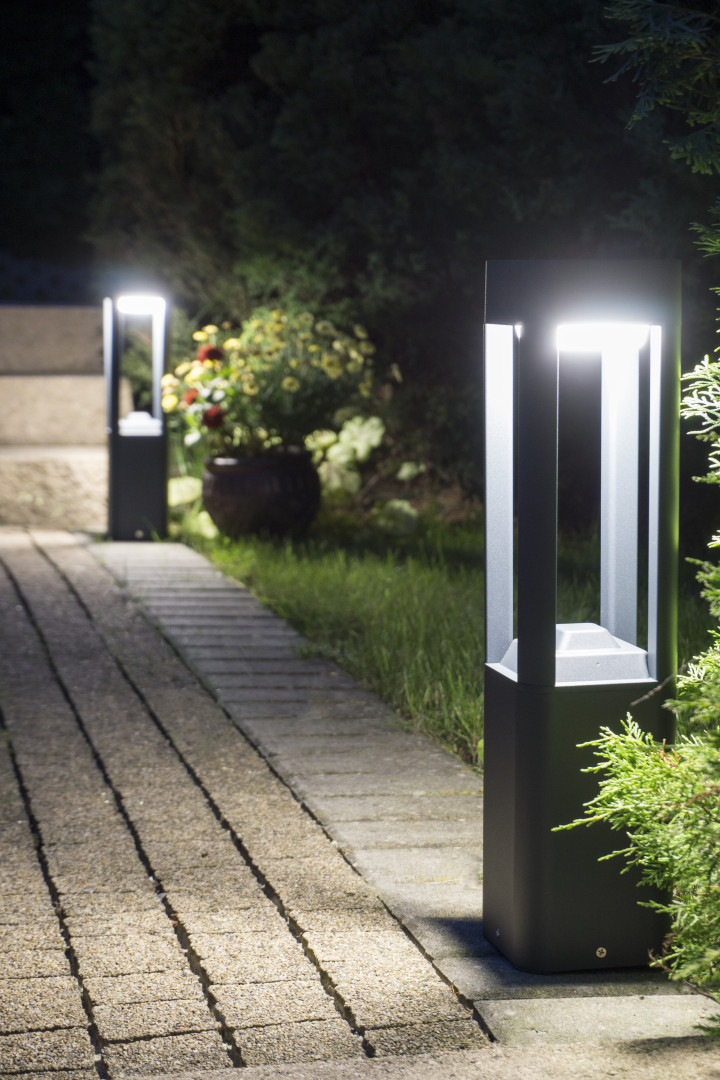
Step 1: Preparing the Electrical installation
If a new electrical installation is required, this step is crucial for the functionality and safety of your lighting system. Before starting, dig a trench 30–50 cm deep, suitable for laying the electrical cable. The depth of the trench should comply with ground conditions and local building regulations. For additional protection, place the cable inside a flexible protective conduit, preferably blue. This color is standard for marking electrical cables and signals their presence underground, helping to prevent accidental damage in the future, for example during landscaping or excavation work.
The cable route should avoid areas exposed to heavy mechanical stress, such as high-traffic pedestrian paths or driveways. Lay the cables as straight as possible, avoiding sharp bends that could compromise their durability. Where cable connections are necessary, use waterproof connectors and junction boxes to protect against moisture and corrosion, which is essential for the longevity and safety of the installation.
Step 2: Preparing the Ground
Floor lamps should be installed on stable surfaces. For hard surfaces such as paving stones, concrete, or wooden terraces, simply drill the appropriate holes to allow for cable routing and secure attachment of the lamp.
If installing on soft ground, such as a lawn, a concrete foundation will be necessary. This can be made on-site or you can use a ready-made, purpose-built concrete base specifically designed for lamp installation. These bases typically come with pre-drilled holes for running electrical cables, which makes the installation much easier. If the base does not have such holes, they must be drilled manually. It is important to choose a foundation that matches the size and weight of the lamp.
Step 3: Routing the Cables
The cables should be routed so that they exit centrally at the lamp’s installation point, leaving enough length to allow for easy connection during the later stage of installation. Next, using a utility knife or a dedicated wire stripper, carefully remove the outer sheath of the cable. Then, gently strip the insulation from the individual wires. It is important to leave an appropriate length of exposed wire—enough to make the connection easily, but not so much that it risks damaging the insulation or the cable itself.
Step 4: Drilling the Mounting Holes
To properly install a floor lamp, start by placing its base in the chosen location. Then, use a pencil to mark the points where holes need to be drilled. Using a drill bit of the appropriate size, drill the holes for the wall plugs. Select the drill bit size according to the type of plugs you plan to use—usually, the lamp manufacturer provides suitable mounting plugs, but if necessary, you can use stronger ones. Make sure the holes are drilled evenly, as any unevenness can affect the lamp’s stability and may cause it to tilt over time.
Step 5: Connecting the Garden Lamps
Properly connecting the wires is crucial for the safe and correct operation of the lamp. First, the electrical wires must be connected to the terminal block or connector inside the lamp. It is important to match each wire to the correct terminal—live (L) is usually brown or black, neutral (N) is blue, and protective earth (PE) is yellow-green. Make sure each connection is secure and tightly fastened to prevent loose wires and potential short circuits.
Step 6: Securing the Lamp to the Ground
After connecting the wires, it’s time to secure the lamp. First, position the lamp base in the designated spot, making sure all wires are properly threaded through the mounting holes. Then, use a level to check that the lamp is perfectly upright and straight. This step is especially important for tall standing lamps, which can easily tilt and compromise their stability. Once you’ve confirmed that the lamp is level, proceed to fasten it to the ground. Use expansion plugs or anchors to securely attach the lamp. Ensure that the mounting is firm and stable to provide long-lasting and safe operation.
Step 7: Installing the Light Source
Installing the light source depends on the type of fixture you have mounted. For LED fixtures with an integrated light source, no additional action is required—the fixture is ready to use immediately after installation. However, if the lamp has a replaceable bulb, installing it may vary depending on the model. In some cases, you may need to unscrew a cover or shade, while in others, you might need to remove part of the lamp’s housing to access the bulb socket. It is important to follow the manufacturer’s instructions carefully to avoid damaging the lamp or improperly installing the light source.
Step 8: Check the Wiring and Connect to the Circuit Breakers
The next step is to carefully check that all wiring connections in junction boxes are properly connected and adequately protected against moisture. This is especially important for outdoor installations, where wires may be exposed to varying weather conditions. Also, ensure that the wires are secured to prevent accidental access by children, which increases the overall safety of the installation.
Equally important is installing the correct circuit breaker to protect the system from overloads and short circuits. If you are not confident about connecting the wires to the breaker box, it is advisable to hire a qualified electrician. This will help avoid mistakes that could lead to serious hazards.
Once the installation and wiring are complete, turn on the circuit breaker for the circuit to which the lamp is connected. Make sure the lamp operates correctly by checking that it turns on without issues and that there are no problems such as flickering or short circuits. If the lamp does not work properly, turn off the breaker and recheck all connections.
Summary”
Installing a standing lamp is a task that requires care, the right tools, and basic knowledge of electrical work. Ensuring a stable base, electrical safety, and proper protection against moisture are key elements that will guarantee the lamp operates reliably for many years.