


Outdoor Lights with Motion and Dusk Sensors – How to Adjust Them and What Is Their Detection Range?
Does your light only switch on when you are already at the door? Or does the sensor cover a larger area than you need? When choosing an outdoor light fitting, check not only its power consumption but also the sensor’s detection range and angle, the lighting duration and the dusk sensor settings. These parameters determine how the light responds to movement around your home.
Outdoor Lights with Motion and Dusk Sensors – Key Information
- The sensor’s detection range determines the distance from which the light can detect movement.
- The detection angle indicates how wide an area the sensor covers.
- On many models, the lighting duration can be adjusted to suit the time needed to pass through a particular area.
- On models with an adjustable dusk sensor, you can set the ambient light level at which the light starts responding to movement.
- An entrance usually requires a smaller detection area than a wide driveway or garage.
How Does an Outdoor Light with Motion and Dusk Sensors Work?
The motion sensor and the dusk sensor perform two different functions. The first detects movement within a specific area, while the second monitors the ambient light level and determines at what brightness level the light can respond to movement. This means the light switches on only when someone approaches the house after dark. On models with an adjustable dusk threshold, you can set the ambient light level at which the motion sensor starts operating.
Read also: Outdoor Lights with Motion and Dusk Sensors and Their Impact on Home Security
What Is the Detection Range of Outdoor Lights with Motion Sensors?
Outdoor light sensors can have a detection range of several metres to more than a dozen metres. Our range includes fittings that detect movement from up to 10 m away, as well as floodlights with a detection range of up to 18 m.
The stated range is the maximum value under specific installation conditions. Sensor performance is affected by factors such as the mounting height, the direction from which a person approaches and the ambient temperature. After installing the light, we recommend checking where the sensor starts detecting movement and, on models with an adjustable range, adjusting the detection area to suit your needs.
We have compared the specifications of selected models available in our store.
1. Ren RN20-KPIR – For an Entrance or a Smaller Area
The Ren RN20-KPIR has a detection range of up to 10 m and a detection angle of 120°. This makes it suitable for front doors, paths leading to the house or smaller garage entrances. The light has a power consumption of 21 W and a luminous flux of 1,710 lm. You can also choose between colour temperatures of 3000 K, 3500 K and 4000 K.
The sensor allows you to adjust the lighting duration and the ambient light level at which it responds to movement. The lighting duration can be set from approximately 8 seconds to 12 minutes.
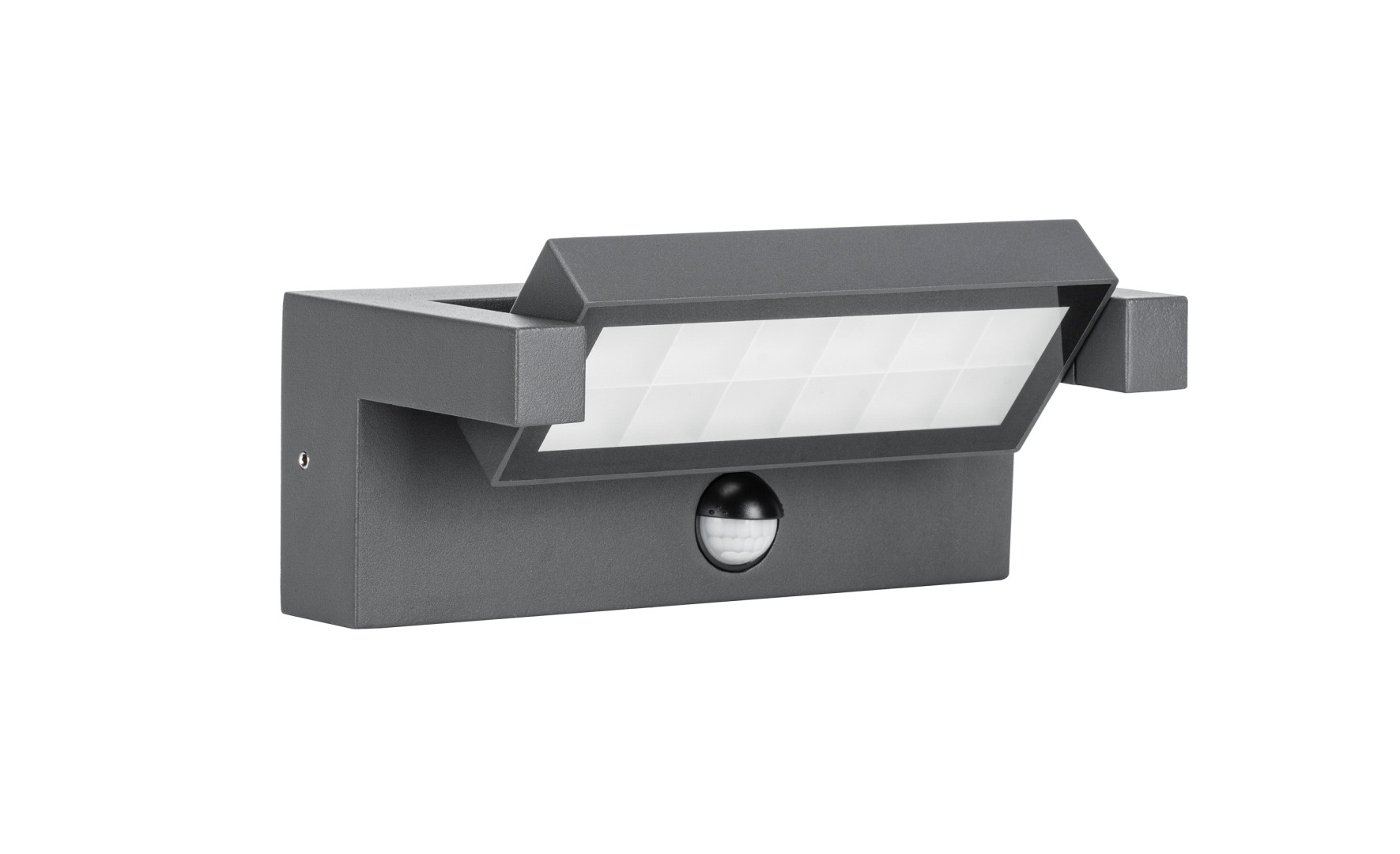 Ren RN20-KPIR outdoor wall light with motion sensor
2. Ren RN600-KPIR-P – For a Larger Driveway or Garage
For a larger area, you can choose the Ren RN600-KPIR-P. With a power consumption of 50 W and a luminous flux of 5,100 lm, it provides significantly more light than the smaller RN20-KPIR. The motion detection range can be set to approximately 8 or 10 m.
A remote control is included with the light. It allows you to adjust the lighting duration, detection range, colour temperature (3000 K, 3500 K or 4000 K) and sensor operating mode. The available lighting durations are 10 seconds, 1 minute and 3 minutes. You can also select a dusk-to-dawn mode that keeps the light on without using motion detection.
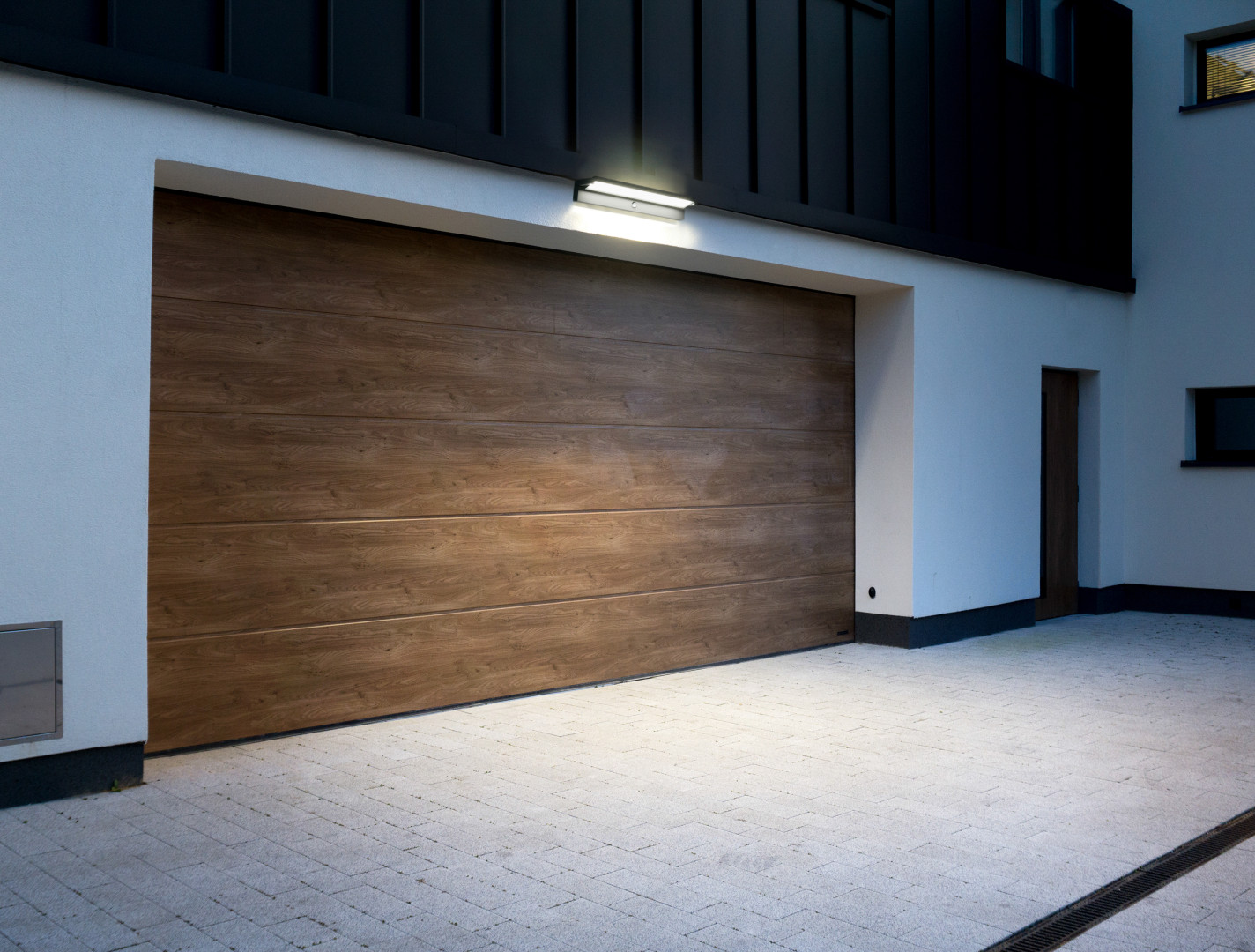
Ren RN600-KPIR-P outdoor wall light with motion sensor
3. Duo 6556-PIR – Wide Detection Angle and Two Adjustable Light Heads
The Duo 6556-PIR has a detection angle of 180° and a maximum detection range of 18 m. Its two independently adjustable light heads allow you to direct the light towards two different areas, such as a driveway and a garage entrance.
The floodlight has a power consumption of 36 W and a luminous flux of 3,000 lm. The sensor allows you to adjust the lighting duration and motion detection range. The instructions specify lighting durations of 1, 3 and 10 minutes, as well as several detection range settings. The model also offers a dusk-to-dawn mode, allowing the light to remain on without detecting movement
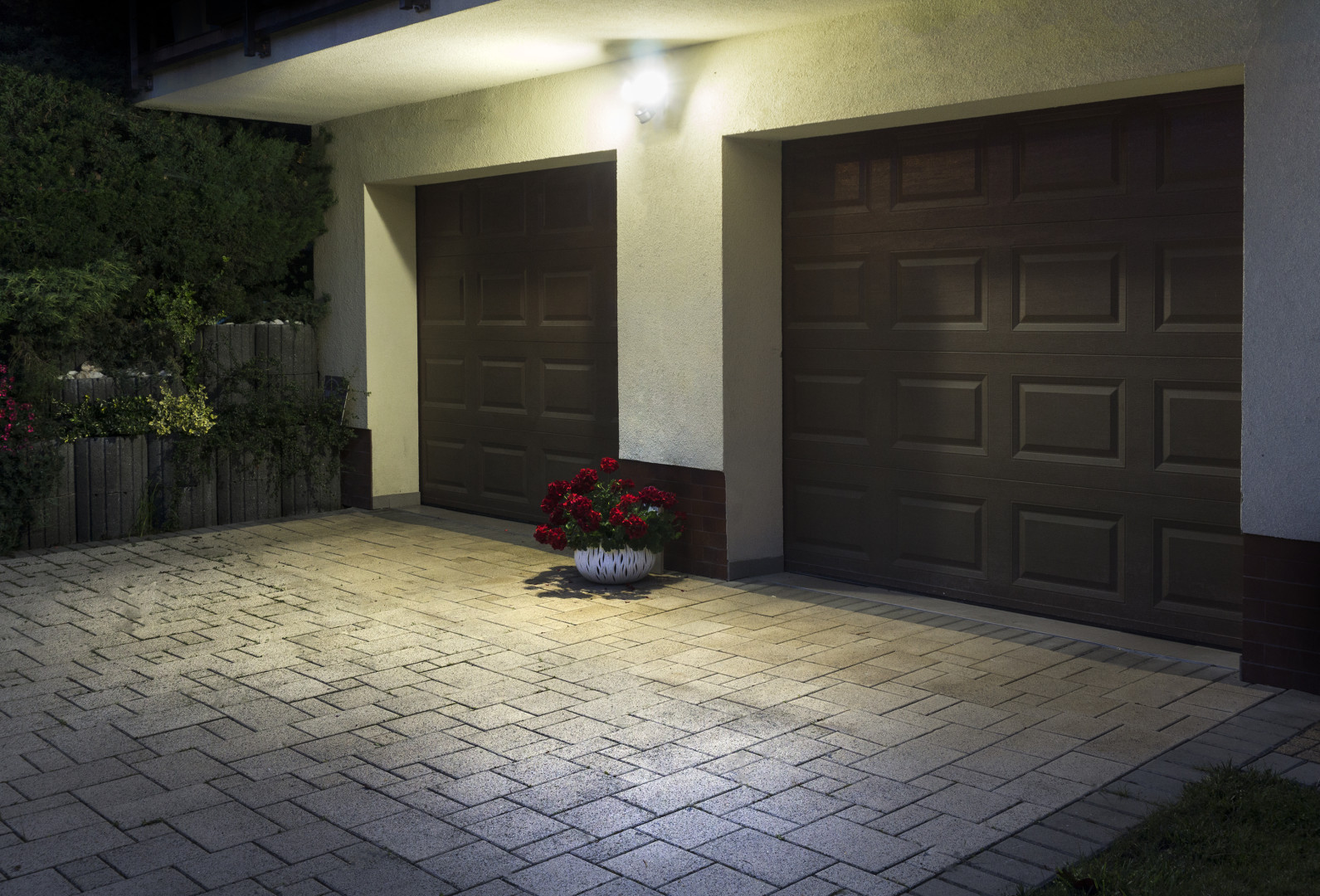
Duo 6556-PIR outdoor LED floodlight with motion and dusk sensors
How to Adjust an Outdoor Light with a Motion Sensor
Position the sensor so that it covers the route you take around your property. Near an entrance, it should detect a person several metres before they reach the door. Near a garage, it should cover the approach to the driveway or the area directly in front of the garage door.
The direction of movement also matters. PIR sensors generally detect people moving across the detection area more effectively than those approaching the sensor directly. It is therefore worth testing the light by walking along your usual route to the house.
There is no need for the sensor to cover the entire street or pavement outside your property. A longer detection range is not always an advantage. For a small entrance, a sensor with an 18 m range may respond to movement much farther away than necessary. The same range can be useful for a wide driveway.
Pay attention to the detection angle as well. A 120° sensor covers a narrower area than a 180° model, making it potentially more suitable for illuminating a specific path or entrance. A wider angle is generally better suited to open spaces in front of a garage or across a driveway.
How to Adjust the Lighting Duration and Dusk Sensor
Adjust the lighting duration to match the time you need to pass through the illuminated area. Near a door, the light only needs to remain on long enough for you to reach the entrance and unlock it. For a driveway, a longer duration may be more practical, allowing you to park and walk to the house comfortably.
On some models, detecting movement again restarts the countdown. This is the case with the Ren RN20-KPIR, so if movement continues within the sensor’s range, the light may remain on longer than the initially selected period.
Adjusting the dusk threshold allows you to determine how dark it must be before the light starts responding to movement. On the RN20-KPIR, this is controlled using the LUX dial. At the maximum setting, the sensor can operate both during the day and at night, while at the minimum setting it responds only when the ambient light level falls below approximately 3 lux.
The Ren RN600-KPIR-P uses different settings. Its remote control allows you to select motion sensor operation throughout the day or only after dark, at an ambient light level of approximately 10 lux. You can also activate a mode in which the light remains on from dusk until dawn without detecting movement.
When choosing a light, also check its luminous flux and available sensor settings. Our range includes outdoor lights with motion and dusk sensors designed for entrances, garages and larger driveways. Explore the available models and choose a fitting that suits its intended installation location and your lighting needs.