


Installation of Garden Lanterns and Park Lights – Step-by-Step Guide
Installing garden lanterns requires building a stable foundation, running electrical wiring underground, and properly anchoring the lighting pole. In this guide, we show step by step how to safely install a park lamp or mast-mounted fixture—both with an integrated LED light source and with a replaceable bulb.
Garden lanterns and park lights are elements that can serve both practical and decorative purposes, adding charm to any space. They can be used to illuminate areas around public facilities such as hotels, restaurants, and businesses, as well as the surrounding green spaces. They can also be successfully used to decorate and illuminate private properties and gardens.
Mast-mounted fixtures are available with modern, integrated energy-efficient LED light sources (such as the Ster Max STRMAX-3000 ) as well as models with replaceable light sources (such as RETRO MAXI OGMWN 1). Such a wide selection of lamps allows the lighting to be tailored to the individual preferences of each user. Some garden masts also offer adjustable height options, allowing them to be installed in a way that perfectly suits the specific space and lighting needs.
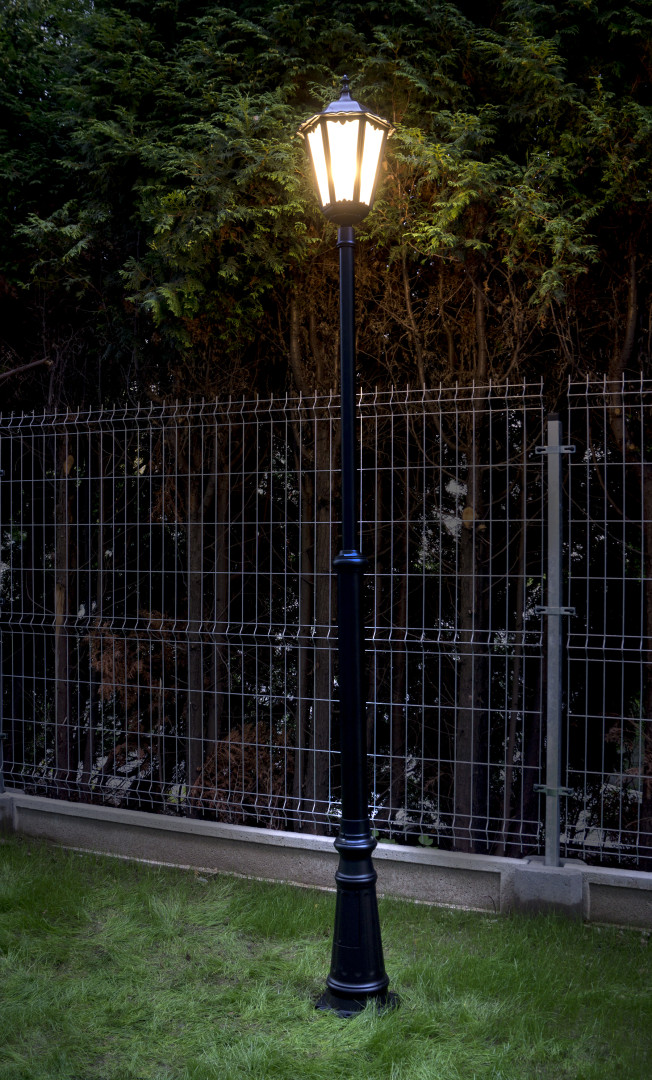
Garden lanterns and park lights are used:
- along paths and walkways
- near entrance gates
- in parking areas and commercial premises
- around hotels and restaurants
- on private properties
In this guide, you will learn:
- What tools are needed to install a park lamp
- How to install garden lanterns step by step
- What the most common mistakes are when installing garden lanterns
Tools Needed to Install a Garden Lantern
Before starting the work, prepare:
- a shovel (for digging the foundation hole)
- a concrete mix or a ready made foundation
- a hammer drill
- mounting anchors
- socket wrenches
- a spirit level
- a voltage tester
- protective conduit (blue)
- electrical terminal blocks and connectors
- a knife or wire stripper
How to Install a Garden Lantern – Step by Step
Step 1. Read the Manufacturer’s Instructions
Before starting the installation of a garden lantern or park light, it is essential to carefully read the manufacturer’s instructions. The manual contains key information regarding the specifics of the installation, as well as guidelines for the correct connection of electrical wires. Following the manufacturer’s recommendations will help prevent damage to the equipment and ensure safe and efficient operation of the lighting.
The most important information included in the instructions:
- the method of anchoring the lighting pole
- the wiring connection diagram
- the permitted power and type of light source
- the ingress protection raiting (IP)
Step 2. Safety When Working with Electrical Installations
When working with electrical installations, it is essential to follow safety regulations. Before starting the installation, make sure that the circuit breakers have been switched off. Use a voltage tester to check whether there is any current in the installation, which will help minimize the risk of electric shock. Inform household members about the ongoing work, and you may also place a notice in the distribution board to prevent the power from being accidentally switched on during the installation.
During the installation of a lighting pole, it is essential to:
- turn off the appropriate circuit breaker
- secure it against accidental switching on
- check with a voltage tester that there is no voltage
- inform household members about the ongoing work
If you do not have experience with electrical work, consider seeking the help of a qualified electrician who will ensure the installation is carried out safely and in accordance with regulations.
Step 3. Planning the Location of the Lighting Pole
Choosing the right location for a garden lantern or park light is crucial. When planning, consider where additional lighting will be most needed (e.g., along pathways, near the entrance gate, or around relaxation areas). You can choose between modern and classic styles that best match the surroundings. It is also important to carefully consider the height of the lighting pole, which should provide the optimal amount of light. Taller poles work well in larger areas (parking lots, commercial gardens), while shorter models are better suited for pathways and terraces.
When planning, consider:
- the distance from paths and driveways
- the height of the lighting pole
- the angle of light distribution
- access to the electrical installation
Step 4. Building the Foundation for the Garden Lantern
Garden lanterns and park lights require a solid concrete foundation to ensure the stability of the structure. You can purchase a ready-made foundation designed for a specific mast light or make one yourself.
To prepare the location, dig a hole of the appropriate depth (usually about 50–60 cm deep).
Fill the hole with concrete or use a ready-made foundation. Remember to use a spirit level to check that the foundation is perfectly level, which is crucial for the proper installation of the lamp. If you use concrete, allow it to cure for at least 24–48 hours before continuing the installation.
Step 5. Preparing the Electrical Installation in the Ground
Safety is crucial when working with electrical installations. Make sure the power supply is switched off and the circuit breakers are secured against accidental activation by others, for example by using a lockout device or placing a notice about the ongoing work. Also ensure that you have the appropriate tools. If you are using ready-made foundations, they should have factory-made openings for running the cable. If the foundation does not have such openings, make them yourself to allow the cables to be routed properly.
The cable installed in the ground should be placed in a blue protective conduit at a depth of 50–60 cm. The conduit protects the wires from mechanical damage and moisture, increasing the safety and durability of the installation. It also helps mark the route of the electrical installation and prevents accidental damage during future excavation work.
Trim the routed cable to the appropriate length so it can be easily connected to the junction box located inside the mast light fixture.
Step 6. Installing the Lighting Pole and Connecting the Wires
After setting the foundation and preparing the electrical installation, position the lighting pole in its final location and mark the points for drilling holes for the mounting anchors. Then drill the holes using a drill, insert the anchors, and make sure they are stable.
Place the mast base on the prepared foundation. Use a spirit level to check that the base is perfectly straight. If it is level, secure it with the appropriate bolts. If the mast has an adjustable height option, adjust it using the connecting pipe between the base and the lantern head. According to the manufacturer’s instructions, connect the cable included in the set to the mast head, and route the other end of the cable to the junction box in the base. Then screw the lantern head into place.
Open the inspection door and, in the electrical junction box inside, connect the cable coming from the head with the cable supplying power. If necessary, strip the appropriate length of insulation from the main cable and individual wires. When connecting the wires using a terminal block, remember to match the wire colors correctly: the live wire (L) is brown or black, the neutral wire (N) is blue, and the earth wire is yellow-green.
Tip: If the mast fixture uses replaceable light sources, it is more convenient to install the bulbs before mounting the lantern head on top of the pole. Replaceable light sources are very practical because they allow for quick replacement in case of failure without the need to replace the entire fixture.
Step 7. Testing the Operation and Adjusting the Position
After completing the installation, check that the lighting works properly, paying attention to any signs of flickering or unstable light, which may indicate loose connections or a potential short circuit. Make final adjustments to ensure the lantern properly illuminates the surrounding area. Also make sure that all components are securely fastened and that there are no visible signs of damaged wiring, which could affect the safety and durability of the installation.
Most Common Mistakes When Installing a Garden Lantern:
- foundation that is too shallow
- lack of protective conduit
- failure to level the pole
- incorrect wiring connections
- cable left too short inside the junction box
Avoiding these mistakes significantly extends the lifespan of the lighting fixtures.
Summary
Proper installation of garden lanterns and park lights requires careful planning, preparation of a solid foundation, and ensuring the safety of the electrical installation. Choosing modern or classic designs, as well as selecting the appropriate technology (such as LED), allows the lighting to be tailored to the needs of even the most demanding users. Thanks to durable materials and proper maintenance, park lighting can serve reliably for many years.
If you encounter difficulties or have doubts about the correct installation, consider seeking help from a qualified electrician to ensure safety and proper operation of the lighting.
If you are also planning to install lower lighting along pathways or driveways, check out our guide on installing standing lamps and light posts, where we show step by step how to properly prepare the installation and mount this type of fixture.
FAQ – Frequently Asked Questions
How deep should the cable be buried for a garden lantern?
The cable should be installed at a depth of 50–60 cm in a protective conduit.
How long does the foundation for a lighting pole need to cure?
Concrete typically requires 24–48 hours to cure before installing the structure.
Does installing a park light require an electrician?
If you do not have experience with electrical installations, hiring a qualified electrician is the safest solution.
Does every garden lantern require a foundation?
For tall lighting poles, a concrete foundation is strongly recommended.