


Which lamps should you choose to illuminate the facade of your house?
In this article, we will discuss which lamps are best for illuminating the facade of a house, what their advantages are, and what to look for when buying them.
Illuminating a house façade is an excellent way to highlight its architectural features and create a unique atmosphere around the property. Choosing the right façade lighting fixtures requires considering several important aspects, such as the architectural style of the house, the type of lighting effect you want to achieve, and the specific functions the fixtures are meant to serve.
In this guide, you will learn:
-
how to light your home – which fixtures to choose for façade lighting,
-
when an outdoor wall light is the right choice and when a spotlight will work better,
-
which technical parameters to pay attention to when making a purchase.
Why is it worth illuminating your home’s façade?
Well-chosen lighting showcases the most attractive architectural elements, giving the building a distinctive character after dark. An illuminated façade increases visibility around the house, making the space more functional and easier to navigate. Proper placement of fixtures can highlight architectural details such as cornices, windows, or entrances, while also adding depth to the façade. It is important that the light is distributed evenly, does not cause glare, and at the same time sufficiently illuminates the area around the house.
Types of outdoor lighting fixtures for façade illumination
The most important step is selecting the right type of fixture. For façade lighting, you can use outdoor wall lights, spotlights, recessed fittings, or ground-mounted standing lamps. Outdoor wall lights are ideal for wall installation, creating upward or downward lighting effects that provide an interesting visual result. Recessed fittings can be installed in the ground, further improving safety after dark.
Here are the most popular types of fixtures used for façade illumination:
Outdoor wall lights
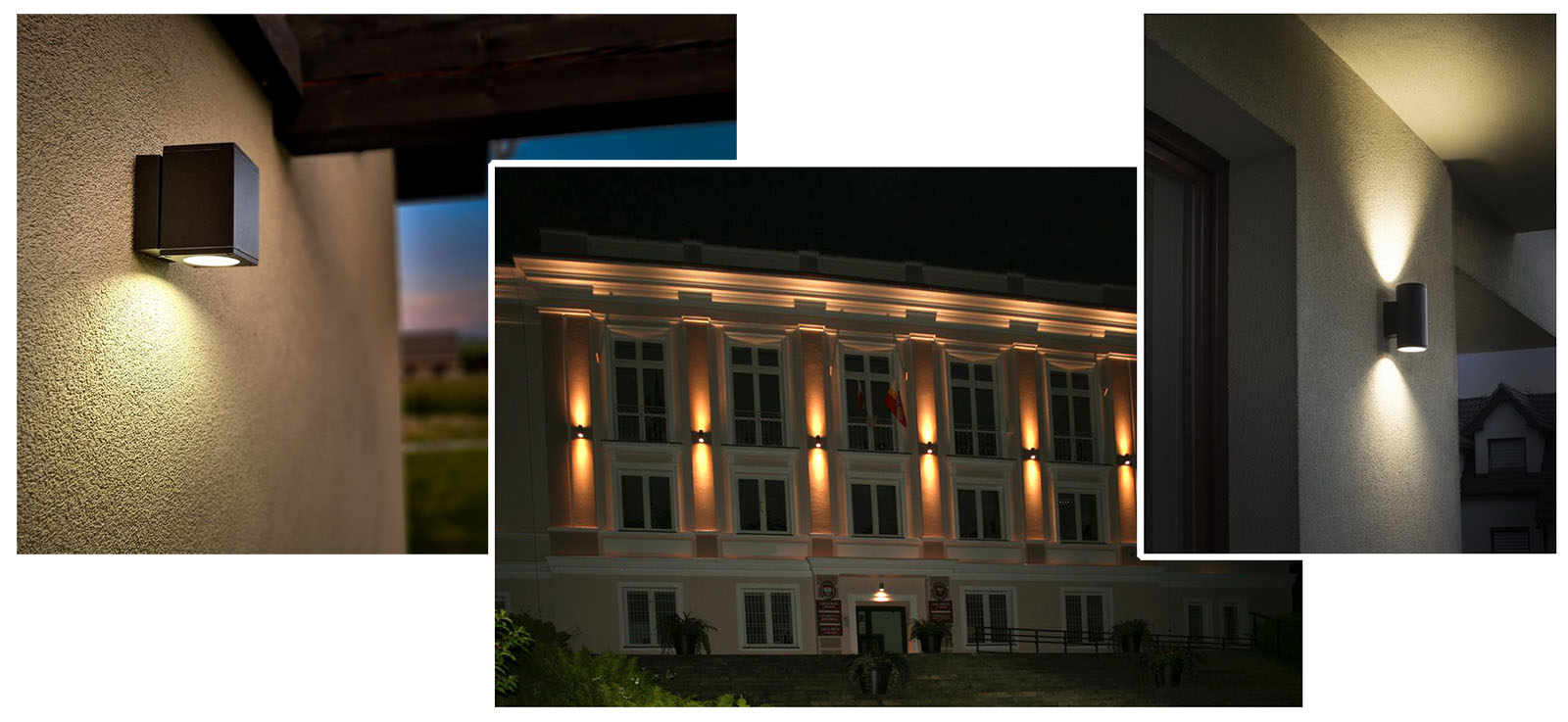
Outdoor wall lights are a classic solution for façade lighting. They are mounted on walls, often next to entrance doors, terraces, or balconies. They are available in various styles – from minimalist, modern designs to more decorative, classic models.
Façade wall lights come in many versions that can be matched to the building’s style and functional requirements. The most popular types include:
Downward-facing wall lights:
These fixtures direct light downward, making them ideal for illuminating paths, entrances, and doorways. They provide gentle, directed light that effectively lights the space below without creating glare. This type of wall light works particularly well in modern façade designs.
Upward-facing wall lights:
These are suitable for emphasizing the height of a building and highlighting architectural features such as cornices or finishing details. Upward-directed light creates a more dramatic lighting effect, making it a great choice for classic or more representative buildings.
Up-and-down wall lights:
These fixtures emit light both upwards and downwards, creating even façade illumination and a subtle lighting effect around the building. They are an excellent choice for modern homes where minimalist design and functionality are key.
Decorative wall lights:
Decorative fixtures are available in a wide range of styles – from rustic and traditional to modern and minimalist. Depending on the look of the house, you can choose richly ornamented wall lights to enhance classic buildings or simple, geometric forms for contemporary façades.
An example of ideal façade lighting fixtures are the Adela series, suitable for larger buildings, and the Adela Midi series, which can be successfully installed on single-family homes.
Garden spotlights – precise façade illumination
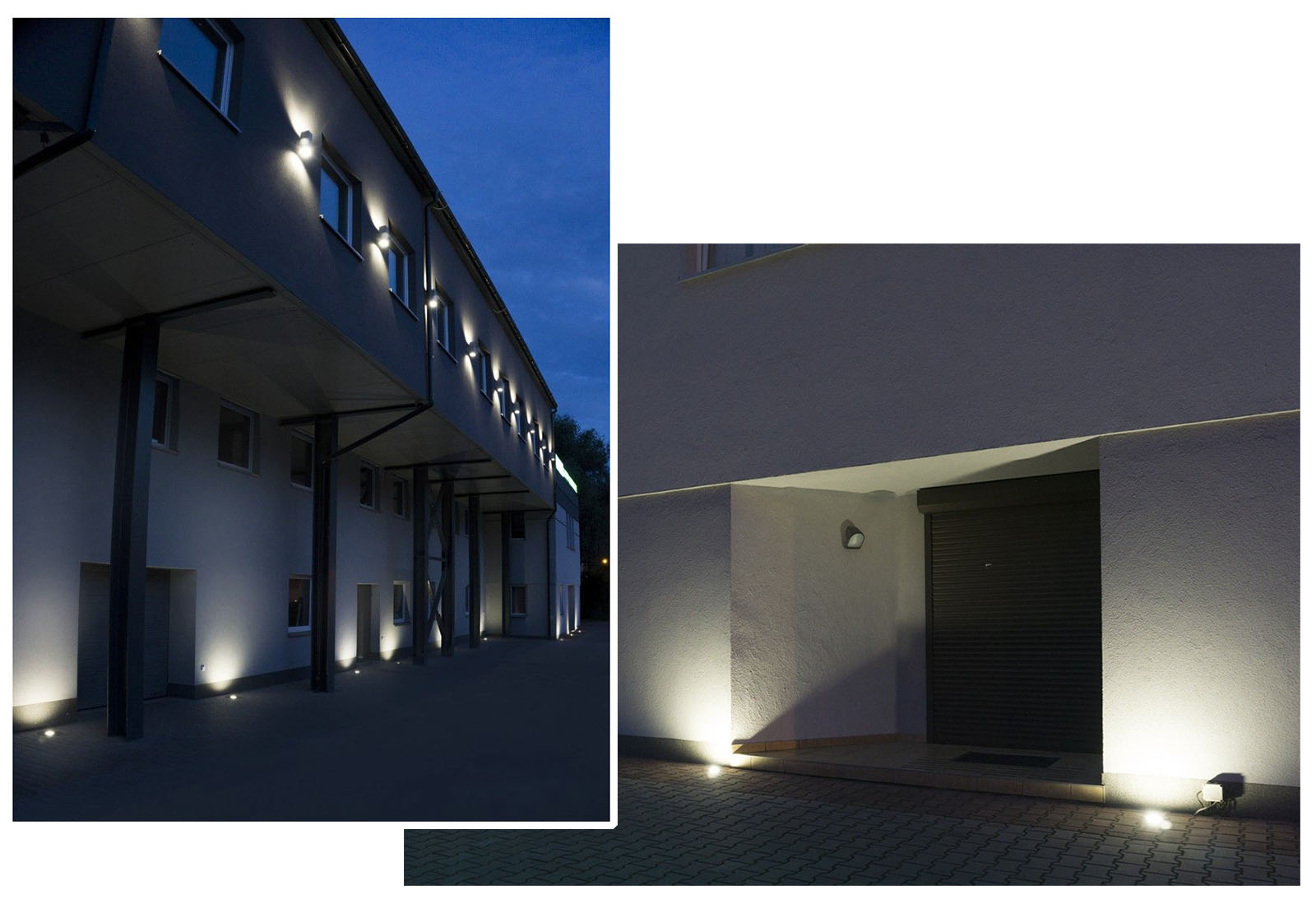
Outdoor spotlights allow you to precisely direct a beam of light onto a selected section of the façade. With their help, you can effectively highlight architectural details such as columns, recesses, or the texture of the façade, as well as evenly illuminate the entire body of the building. This solution offers great flexibility in lighting design, enabling you to achieve both a subtle accent effect and strong, decorative wall illumination.
Outdoor spotlights – available options
Wall-mounted spotlights
These are installed directly on the building façade, allowing you to direct light onto specific elements such as windows, doors, or other architectural details. Adjustable wall spotlights make it possible to precisely control the direction of the light beam.
Garden spotlights – ground-mounted or spike-mounted
These fixtures are installed on hardened surfaces or, in the case of spike-mounted models, directly in the ground. They are a practical solution for illuminating façades from a distance and for highlighting selected architectural elements.
In-ground fittings – discreet fixtures installed in the surface
These spotlights are installed at ground level and directed upwards, allowing for effective illumination of the lower part of the façade, columns, trees, or even the entire building structure. They are often used in modern designs, where uplighting creates an interesting visual effect.
In our range, you will find several series of in-ground fittings that vary in size and shape. The most popular is the Mix in-ground lighting series, which allows adjustment of the bulb tilt angle. You can find other models on our website in the in-ground lighting category.
Factors to consider when choosing lighting fixtures
Light colour
The choice of light colour has a significant impact on the final appearance of the façade.
Warm white (2700–3000K):
Creates a cosy, homely atmosphere. Works particularly well with buildings featuring traditional architecture.
Neutral white (3500–4000K):
A versatile option that suits most façades, especially those with a modern design.
Cool white (5000–6000K):
Adds a modern, elegant character to a building, but may appear too harsh, especially on older properties.
You can find more information about selecting the right light colour in our guide: Light colour in outdoor lighting fixtures.
IP rating (Ingress Protection)
Outdoor lighting must be resistant to weather conditions, so it is important to check the IP rating. All fixtures in our range have an appropriate IP rating for outdoor use.
Beam angle of the light source
The beam angle determines how widely the light spreads in space. It affects whether the light is focused on a single point or evenly dispersed over a larger surface.
Beam angle 10–30° – narrow beam, ideal for highlighting architectural details such as columns, sculptures, or other specific façade elements. Spotlights with this characteristic provide concentrated light and create a focused lighting effect.
Beam angle 30–60° – medium beam, versatile and commonly used for illuminating medium-sized sections of a façade or areas directly adjacent to the building. The light is more diffused but still controlled.
Beam angle 60–120° – wide beam, used to illuminate larger sections of the façade or the surrounding area. This type of light is more dispersed and effectively lights up the entire façade or a larger space around the house.
Beam angle above 120° – very wide beam, used for evenly illuminating entire areas such as driveways, gardens, terraces, or large façades. Fixtures with this beam angle work well as general lighting.
Summary
Façade lighting is an investment that can significantly enhance both the aesthetics and functionality of your property. Choosing the right fixtures depends on the building’s characteristics, the desired effect, and your aesthetic preferences. Whether you opt for classic wall lights, modern spotlights, or in-ground fittings, remember to select energy-efficient and durable fixtures designed to withstand outdoor conditions. This will ensure that your façade looks impressive not only during the day but also after dark.