


Lighting Around the House – 5 Areas That Are Most Often Left Poorly Lit. Which Lights Should You Use?
The driveway and main entrance are usually well lit. However, less attention is often paid to the side wall of the house, the area where waste bins are kept or the steps leading down from the terrace – even though these areas also need to be safe to navigate after dark. Here’s how to plan lighting around your home in these often-overlooked areas and which lights to choose.
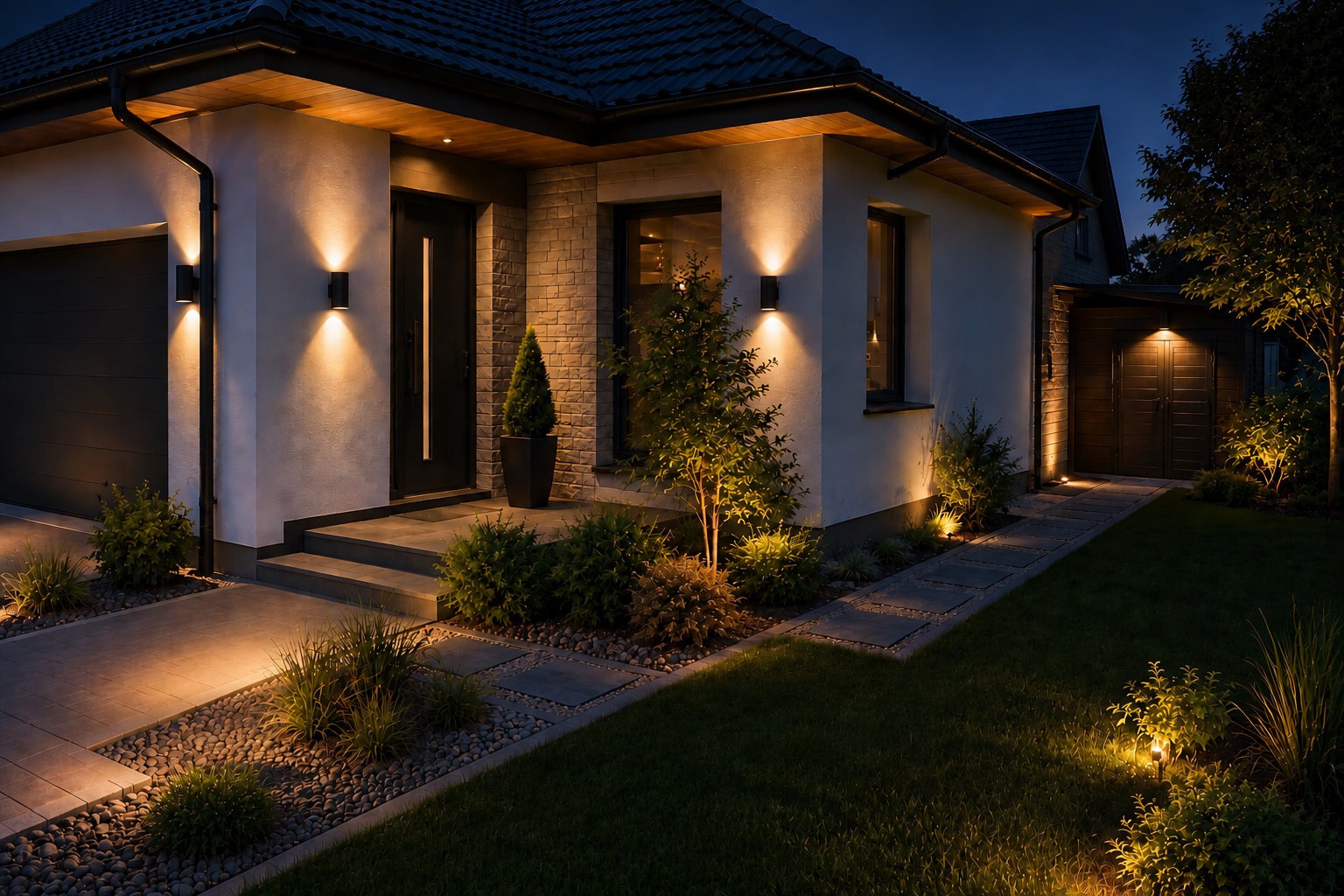
Lighting Around the House – Key Information
- A narrow side passage is best illuminated with a small wall light that does not protrude far from the façade and directs light onto the ground.
- A light with a motion sensor is useful near a secondary entrance, as it does not need to remain on throughout the evening.
- Near waste bins, the lighting should cover both the access path and the area where the bins are opened.
- It is worth illuminating the house number separately if the light by the door does not adequately illuminate the plaque.
- At the steps leading down from the terrace, a low-mounted fixture is the best choice, as it can highlight the edges of the steps.
Which Areas Are Most Often Left Without Adequate Outdoor Lighting?
The areas most often overlooked are those located away from the main route from the gate to the front door. They do not need strong lighting at all times, but after dark, even a single missing light point can make it more difficult to walk through the area, open a door or access the utility areas of the property.
Here are the areas that, in our opinion, most often require additional lighting.
1. Side Passage Between the House and the Fence
In a narrow passage, a slim wall light works well because it takes up little space and allows the light to be directed towards the ground. The beam is best aimed downward or at a slight angle towards the pathway, so that the surface is clearly visible without the light source shining directly into your eyes.
A good example is the Rota RT-K100. It is 8.5 cm deep and features an adjustable head, allowing the light to be directed towards the pathway rather than straight at the wall. This setup is useful for a side path leading to the garden, gate or utility area of the house.

Rota RT-K100 Wall Light
2. Utility Entrance or Side Door
At a garage, boiler room or utility room door, it is worth installing a wall light with motion and dusk sensors. The light switches on as you approach, making it easier to see the threshold, door handle and surface in front of the entrance without having to keep a less frequently used part of the property illuminated.
The Ren RN20-KPIR wall light available in our store features a sensor with a 120° detection angle and a range of up to 10 m, allowing it to detect movement before you reach the door. You can also adjust the lighting duration after motion is detected and choose between 3000, 3500 or 4000 K colour temperature.
When installing the fixture, it is worth checking the sensor’s detection direction so that the light responds to a person approaching the entrance rather than primarily detecting movement further away from the door.
3. Area Around the Waste Bins
When lighting an area around waste bins, it is not only the visibility of the bins themselves that matters, but also the path leading to them. The light should therefore cover both the access path and the bins, making it possible to see the lid, handle and surrounding surface after dark.
If the area is wider or located further from the entrance, a fixture with two adjustable heads can be useful. The Duo 6556-PIR allows the heads to be adjusted independently – one can be directed towards the access path and the other towards the bins.

Duo 6556-PIR Double Spotlight
This model features motion and dusk sensors with a 180° detection angle and a maximum range of 18 m, so it is worth adjusting the sensor’s settings to the size and layout of this part of the property.
4. House Number on the Façade
The house number may be clearly visible during the day but fall outside the reach of the light by the door after dark. If the number plaque is mounted separately, it is worth directing light onto it from above.
The Adela Midi M1459 DG features a downward-facing light source and is also designed for illuminating house numbers. The GU10 socket allows you to choose the bulb yourself and, with it, adjust the colour temperature and brightness of the light.
5. Steps from the Terrace to the Garden
At steps, the light should primarily illuminate the surface and edges of each step. A wall light mounted high up may brighten the terrace, but it will not always provide enough light to clearly show the first and last step.
For stairs, small fixtures installed low in the wall, retaining wall or structure next to the steps work particularly well. Their purpose is not to strongly illuminate the entire area, but to highlight the surface and changes in height.
An example is the Mur-Led M2031. The light source is positioned to illuminate the area below the fixture. The model is suitable for illuminating steps made of paving blocks, wood and concrete, among other applications. It features an integrated 3000 K LED light source and an IP65 rating.

Built-In Light MUR-LED M2031
Read: How to Plan Outdoor Lighting Around Your Home Step by Step
Do All Lights Around the House Need to Stay On All Evening?
Not every part of the property requires constant lighting.
For a utility entrance, waste bins or a less frequently used passage, a motion-activated light may be more convenient. Permanent lighting is better suited to areas where you spend more time or where a particular feature should remain visible throughout the evening, such as the main entrance or house number.
With sensor-equipped lights, it is worth considering not only the maximum detection range, but also whether the lighting duration and dusk threshold can be adjusted. This helps reduce accidental activation and allows the fixture’s operation to be tailored to how a particular area of the property is used.
When planning outdoor lighting around your home, walk through the routes you most often use in the evening – not just the path from the gate to the front door. Explore our range of outdoor lighting and choose fixtures suited to the different areas of your property.